After taking Larry Seiler's course and chatting with him on WetCanvas, he inspired me to try plein air painting. I figured painting in public couldn't be any more intimidating than posting paintings online for the whole world to see. After a few years of doing that, I don't even think about it anymore, but I still remember the first few times I hit the send key. So I know it will be a little scary the first couple of times, but hopefully it will become an addictive habit.
The first thing I needed was a painting box. After doing some investigating I settled on a Guerrilla Thumbox. This pochade box is very compact and suits my needs for painting 4 x 6, 5 x 7 and 6 x 8 panels. Small paint tubes, short handled brushes, a palette knife, a small brush cleaner, a small oil tin and a few other objects can be stored inside the box below the sliding palette. I hope to be able to mix my paint on the palette before going out to paint. That should cut down the time needed to be in view of the public. It also will also allow me to get right to painting when I get to the painting location.
I thought it might be a good idea to use the Thumbox in my studio to give it a try before going plein air painting. It was a little different at first, but after a while it was just painting as normal. There will be things to learn, but the only way to learn is to do it. Maybe my next post will be a plein air painting. We will see.
This painting is done on a 4 x 6 canvas panel and I used Windsor & Newton Artisan water mixable oil colors. I used a split complementary palette of ultramarine blue, cadmium yellow medium and cadmium red deep hue along with titanium white. I really like the greens you can make with this palette.
I am including a photo of the Thumbox with the painting. Thanks for looking.
#43
The Guerrilla Thumbox
Doug
A blog about daily painting. The goal is to paint 120 small paintings, mostly in pastel, but there could be some paintings in gouache, acrylics, oils or watercolor. Landscapes and still life paintings will be the major focus. This blog is about the journey towards improvement and experimenting with different techniques and mixing media.
Monday, June 4, 2012
Wednesday, May 30, 2012
Which Way to the Beach?
I have painted this scene a few times in pastel, but this is the first time in oils. There is something inviting about the composition. Probably the path to the water leads the viewer into the painting. The photo reference is by Paula Ford, a fabulous artist who has helped me over the past five years at WetCanvas.
We are lucky to be the proud owners of three of Paula's beautiful pastel paintings. When I saw them in person for the first time it opened my eyes to how different paintings look when viewing them online. It also showed me how far I still have to go as a painter. Aim high!
This is painted on a 5 x 7 canvas panel using Windsor & Newton Artisan WMO's and I used the same palette as the last two paintings. Thanks for looking.
#42
Doug
We are lucky to be the proud owners of three of Paula's beautiful pastel paintings. When I saw them in person for the first time it opened my eyes to how different paintings look when viewing them online. It also showed me how far I still have to go as a painter. Aim high!
This is painted on a 5 x 7 canvas panel using Windsor & Newton Artisan WMO's and I used the same palette as the last two paintings. Thanks for looking.
#42
Doug
Tuesday, May 29, 2012
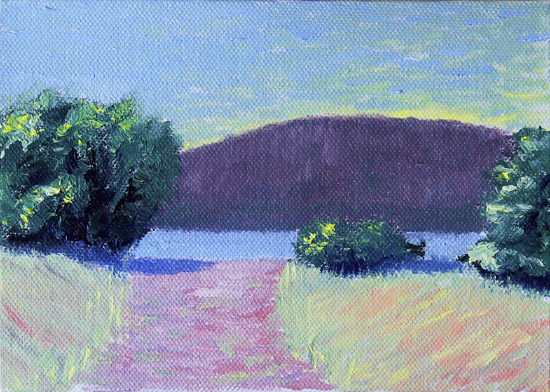
High Water
As soon as I saw the photo that I took last week at the bird sanctuary in Salmon Arm, I knew I had to paint it. Now I'm not too sure. Usually a shrub or tree would have a darker value than the background hill, but the photo showed differently. I know you should never trust a photo, but it looked correct to me. When you live in an area with evergreen trees everywhere you look, the hills and mountains can look very dark. I guess I could just say the sun was shining on the shrub, but the background was cloudy. Now that I am typing my thoughts out it makes perfect sense. It is up to me to decide what the painting looks like and I can have the sun shine anywhere I want. I feel better now that I won that argument with myself. Or did I lose it?
Shuswap Lake is on the rise with the runoff of melting snow from the surrounding mountains and you get scenes like this quite often. Normally this little bush would be far back from the lake, but right now it doesn't have to look too far for water. It looks like it is just standing there in defiance, daring the lake to come any closer. I don't know if I would have taken the photo a few months ago. It wasn't a great photo, but I thought it could make an interesting painting. I am learning to take photos for painting references now, not for beautiful photos. There is a big difference.
This is painted with Windsor & Newton Artisan WMO's and is painted on a 4 x 6 canvas panel. I used the same triad as yesterday. The paint was a little sticky, but still workable. I didn't time myself, but it probably took between thirty to forty minutes to paint.
Thanks for looking.
#41
Doug Wasilieff
Monday, May 28, 2012
One Pastel and One Oil
Life has been hectic around here for the past week, but things are back to normal now and I should get back to painting more often. Hopefully I can get back to painting daily, because I feel like I learn more when I paint for a few days in a row. I guess one gets in a groove and you start doing things without thinking. My wife says I do that all the time.
I have two paintings today. The first is painted in pastels and it took a couple of days to finish. It's not that it took that long, it was just trying to find time to paint. It is always hard for me to go back to a painting the next day and continue painting. Maybe it is because when you start a painting you vision it in your mind and if you have to stop painting and start again the next day, the vision is gone. Could it be that the excitement is gone? I know a lot of painters who take many sessions to complete a painting and they do a great job on it. I think if you finish a painting in one sitting, it helps you achieve a looser look. Makes sense to me.
Here is number 39, a pastel painting that is painted on 5 x 7 brown Pastelmat. I did a little experiment with this one, using just the Maggie Price Value Set of Terry Ludwig pastels. It is a sixty pastel stick set made up of ten hues and each hue has six values. I kept track and I used eighteen sticks for the painting. This would be a limited palette for pastels. This is painted from a reference photo of mine.
#39
This is number forty. A third of the way through the challenge. It is a water miscible oil painting using Windsor & Newton Artisan paint and is painted on a 5 x 7 canvas panel that was toned with mud made from leftover paint from the last oil painting. I used a limited palette again, but this time I used a triad of ultramarine blue, lemon yellow and cadmium red hue along with titanium white. The same method as the last painting was used, mixing three tones of each hue and mixing the hues together, getting three tones of each mixture. I really enjoy using a limited palette that is already mixed. You just paint and don't worry about not having the "right" color. You just use the closest color and value you have and go for it. Fun stuff!
#40
Thanks for looking.
Doug Wasilieff
I have two paintings today. The first is painted in pastels and it took a couple of days to finish. It's not that it took that long, it was just trying to find time to paint. It is always hard for me to go back to a painting the next day and continue painting. Maybe it is because when you start a painting you vision it in your mind and if you have to stop painting and start again the next day, the vision is gone. Could it be that the excitement is gone? I know a lot of painters who take many sessions to complete a painting and they do a great job on it. I think if you finish a painting in one sitting, it helps you achieve a looser look. Makes sense to me.
Here is number 39, a pastel painting that is painted on 5 x 7 brown Pastelmat. I did a little experiment with this one, using just the Maggie Price Value Set of Terry Ludwig pastels. It is a sixty pastel stick set made up of ten hues and each hue has six values. I kept track and I used eighteen sticks for the painting. This would be a limited palette for pastels. This is painted from a reference photo of mine.
#39
This is number forty. A third of the way through the challenge. It is a water miscible oil painting using Windsor & Newton Artisan paint and is painted on a 5 x 7 canvas panel that was toned with mud made from leftover paint from the last oil painting. I used a limited palette again, but this time I used a triad of ultramarine blue, lemon yellow and cadmium red hue along with titanium white. The same method as the last painting was used, mixing three tones of each hue and mixing the hues together, getting three tones of each mixture. I really enjoy using a limited palette that is already mixed. You just paint and don't worry about not having the "right" color. You just use the closest color and value you have and go for it. Fun stuff!
#40
Thanks for looking.
Doug Wasilieff
Tuesday, May 22, 2012
Pastel Painting Using the Same Reference Photo
When I was painting with oils yesterday I couldn't stop thinking how the painting would look using pastels. Today I found out. Although it has been a while since I had my sticks out, it felt good to get my fingers dusty again. I think I will be able to go back and forth using pastels or oils, depending on my preference that day.
I wanted to keep a loose feeling to the painting. Not too much detail. I think my oil paintings are looser than my pastel paintings, but this is a step in the right direction. There is a thread over in the Pastel Talk forum at WetCanvas about finding your style. I have always said that I am waiting for my style to find me. It may sound corny, but that is how I feel. I don't think you can consciously pick your style without it looking forced. When you start painting using the right side of your brain, painting in the zone, that is when your style emerges. That's my theory and it's my blog so I can say what I want (hehe).
This is painted on 5 x 7 Belgium Mist Wallis sanded paper using a variety of soft pastels including Terry Ludwig, Mount Vision and Unison. It took me about two hours. Thanks for looking.
#38
Doug Wasilieff
I wanted to keep a loose feeling to the painting. Not too much detail. I think my oil paintings are looser than my pastel paintings, but this is a step in the right direction. There is a thread over in the Pastel Talk forum at WetCanvas about finding your style. I have always said that I am waiting for my style to find me. It may sound corny, but that is how I feel. I don't think you can consciously pick your style without it looking forced. When you start painting using the right side of your brain, painting in the zone, that is when your style emerges. That's my theory and it's my blog so I can say what I want (hehe).
This is painted on 5 x 7 Belgium Mist Wallis sanded paper using a variety of soft pastels including Terry Ludwig, Mount Vision and Unison. It took me about two hours. Thanks for looking.
#38
Doug Wasilieff
Labels:
daily painting,
Doug Wasilieff,
landscape,
Mount Vision,
original pastel painting,
pastel,
pastel drawing,
pastel painting,
pastels,
right brain,
soft pastel,
Terry Ludwig,
Unison,
Wallis,
WetCanvas
Monday, May 21, 2012
WetCanvas WDE
Every weekend over at WetCanvas.com, they have a challenge called the WDE where a host posts sixteen photos and you pick one to paint or draw and post your results. The goal is to take less than two hours to complete, but if you are not finished you take a photo and post it at the two hour mark and when it is finished you take another photo and post the results. It is a fun challenge and can get you out of a rut. This weekend was hosted by a fellow Canuck, mbeckett, who posted some wonderful photos to choose from. Thanks, Mike.
I decided to continue with the water miscible oils and see what happens. I am not too sure about this one, but it is another step to the 120 mark. It is done using just three hues and white again. I sure like painting with a limited palette and can see the advantages it would give an artist painting plein air. Premix three tones in each hue and mix each color with another and make three tones of those. This is done with a split complementary palette of lemon yellow, ultramarine blue and dioxazine purple along with titanium white. I mixed a pile using all three colors and a little white and used it to tone the canvas to get rid of the white. I also used a bit of the mixture to mute colors when I needed to tone the color down. It is painted Windsor & Newton Artisan WMO's and is painted on a 5 x 7 canvas panel. It took just over an hour to complete.
Thanks for looking.
#37
Doug
I decided to continue with the water miscible oils and see what happens. I am not too sure about this one, but it is another step to the 120 mark. It is done using just three hues and white again. I sure like painting with a limited palette and can see the advantages it would give an artist painting plein air. Premix three tones in each hue and mix each color with another and make three tones of those. This is done with a split complementary palette of lemon yellow, ultramarine blue and dioxazine purple along with titanium white. I mixed a pile using all three colors and a little white and used it to tone the canvas to get rid of the white. I also used a bit of the mixture to mute colors when I needed to tone the color down. It is painted Windsor & Newton Artisan WMO's and is painted on a 5 x 7 canvas panel. It took just over an hour to complete.
Thanks for looking.
#37
Doug
Thursday, May 17, 2012
Pigment Soup
No, it's not something an artist makes for dinner. It's a term Larry Seiler came up with for the mixture of left over paint from the previous painting. You just get the palette knife out and mix all of the paint into one pile of mud. It's pretty mud though. Mine turned out to be a beautiful red grey. I didn't know mud could look so good.
The first thing I did was tone the canvas panel with the mixture. I spread the mixture onto the canvas and rubbed it in with a paper towel, rubbing until the surface was a nice light red grey. I then added a touch of the mixture to all of the piles of paint from the last painting. This unifies the colors and the theory is that no matter what pile of paint you choose, the colors will all look fine together. This is all new to me, but it sounds reasonable.
It was a good experiment for someone like me, a color geek. I am looking at this painting beside the last painting and I can see how the muted painting makes the other painting look that much more colorful. Using pure and muted tones together in a painting only makes sense. That's what this challenge is for. I am learning as I go.
This is painted with Windsor & Newton Artisan WMO paint and is painted on a 5 x 7 canvas panel from a photo in the WetCanvas Image Reference Library. Thanks to Paula Ford for the photo. I am happy to say this took less than an hour to paint. Having the all the paint premixed sure helps. Three values of each hue and away you go.
Thanks for looking.
#36
Doug
The first thing I did was tone the canvas panel with the mixture. I spread the mixture onto the canvas and rubbed it in with a paper towel, rubbing until the surface was a nice light red grey. I then added a touch of the mixture to all of the piles of paint from the last painting. This unifies the colors and the theory is that no matter what pile of paint you choose, the colors will all look fine together. This is all new to me, but it sounds reasonable.
It was a good experiment for someone like me, a color geek. I am looking at this painting beside the last painting and I can see how the muted painting makes the other painting look that much more colorful. Using pure and muted tones together in a painting only makes sense. That's what this challenge is for. I am learning as I go.
This is painted with Windsor & Newton Artisan WMO paint and is painted on a 5 x 7 canvas panel from a photo in the WetCanvas Image Reference Library. Thanks to Paula Ford for the photo. I am happy to say this took less than an hour to paint. Having the all the paint premixed sure helps. Three values of each hue and away you go.
Thanks for looking.
#36
Doug
Subscribe to:
Posts (Atom)